How Does Air Conditioning Work?
Air conditioning has become an essential part of modern life. Whether you’re cooling a family home during a UK heatwave, and this summer of 2026 has proved to be one of the hottest on record. Northampton has hit many record highs this year. Moulton AC have installed More systems this year than we ever imagined.
keeping an office comfortable for employees, or maintaining the perfect temperature in a server room, air conditioning systems make indoor environments healthier, more comfortable, and more productive. Modern air conditioners do much more than simply blow cold air. They remove heat from inside a building, reduce humidity, filter airborne particles, and circulate fresh air to create a pleasant indoor climate. Many modern systems can even reverse their operation to provide highly efficient heating during colder months.
Although air conditioning may appear complicated, the technology behind it follows surprisingly simple scientific principles. Instead of creating cold air, an air conditioner moves unwanted heat from inside your property to the outside. This process is known as the vapour-compression refrigeration cycle, and it has remained the foundation of air conditioning technology for well over a century. Improvements in compressors, refrigerants, electronic controls, and inverter technology have made today’s systems quieter, more energy efficient, and significantly more environmentally friendly than earlier generations.
What Is Air Conditioning?
Air conditioning is the controlled process of regulating indoor temperature, humidity, air quality, and airflow. While most people associate air conditioning with cooling, a modern system performs several important functions simultaneously.
These include:
| Function | Purpose |
|---|---|
| Cooling | Removes unwanted heat |
| Dehumidifying | Reduces excess moisture |
| Air Filtration | Removes dust, pollen and allergens |
| Air Circulation | Keeps fresh air moving |
| Heating (reverse-cycle systems) | Provides efficient winter heating |
This combination creates a much healthier indoor environment. High humidity often makes warm weather feel even hotter because sweat cannot evaporate efficiently. By removing moisture as well as heat, air conditioning makes rooms feel noticeably cooler than temperature alone would suggest. This is one reason why properly designed air conditioning systems improve comfort so effectively during hot, humid conditions.
The Science Behind Air Conditioning
The biggest misconception is that an air conditioner somehow creates cold air. It doesn’t. Instead, it transfers heat from one location to another using the laws of thermodynamics.
Think of it like moving water from one bucket to another. The heat doesn’t disappear—it simply changes location.
The secret ingredient is refrigerant, a specially designed fluid capable of changing between liquid and gas at relatively low temperatures. Whenever the refrigerant changes state, it either absorbs or releases heat.
This constant cycle allows the system to continuously remove warmth from indoors and release it outside.
Heat Transfer Explained
Heat naturally moves from warmer objects toward cooler ones. Air conditioning forces this process to happen faster and in a controlled direction.
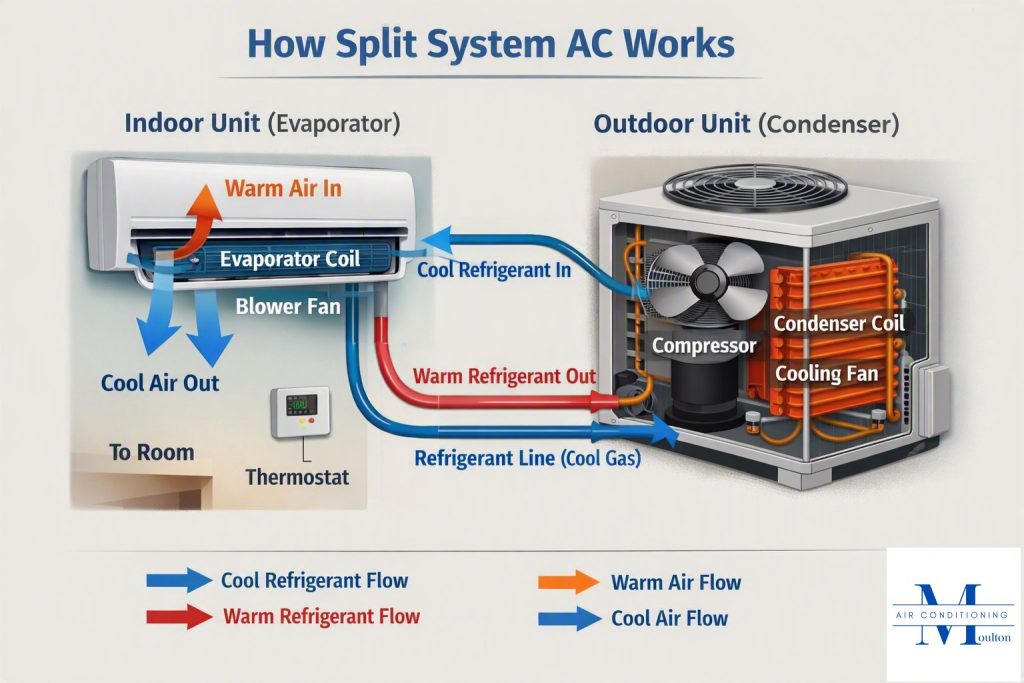
Warm indoor air passes over extremely cold evaporator coils.
The refrigerant inside these coils absorbs the heat.
As it absorbs heat, the refrigerant boils into a gas.
The cooled indoor air is then blown back into the room.
Meanwhile the heated refrigerant travels outdoors where the unwanted heat is released before the cycle begins again.
The Four Stages of the Refrigeration Cycle
Stage 1 – Evaporation
Everything begins inside your home.
A fan pulls warm indoor air across the evaporator coil. The refrigerant inside the coil is extremely cold and at low pressure.
As warm air passes over the coil, the refrigerant absorbs the heat energy.
This causes the refrigerant to evaporate into a gas while simultaneously cooling the air that returns to your room.
Moisture from the air also condenses onto the coil, explaining why air conditioners naturally reduce humidity.
Stage 2 – Compression
The refrigerant is now a warm gas carrying heat removed from your home.
It travels to the compressor located within the outdoor unit.
The compressor dramatically increases the refrigerant’s pressure.
Increasing pressure also raises its temperature, making it much hotter than the outside air.
This prepares it to release the absorbed heat.
Stage 3 – Condensation
The hot, high-pressure refrigerant flows through the outdoor condenser coil.
A powerful fan blows outdoor air across these coils.
Since the refrigerant is hotter than the outside air, heat transfers outdoors.
As heat leaves, the refrigerant changes back into a liquid.
This explains why the outdoor unit blows warm air—it is literally dumping unwanted heat outside.
Stage 4 – Expansion
Before returning indoors, the liquid refrigerant passes through an expansion valve.
Its pressure suddenly drops.
Lower pressure means lower temperature.
The refrigerant becomes extremely cold once again and returns to the indoor evaporator.
The entire cycle repeats continuously until the desired room temperature is reached.
Main Components of an Air Conditioner
Every modern air conditioner relies on several key components working together.
Indoor Unit
The indoor unit usually contains:
- Evaporator coil
- Fan
- Air filter
- Temperature sensors
Its primary job is to absorb heat from indoor air while distributing cooled air evenly throughout the room.
Outdoor Unit
The outdoor unit contains:
- Compressor
- Condenser coil
- Cooling fan
Many people assume this unit creates cold air, but its real purpose is to dispose of the heat removed from your building.